Package:
metaldock-vwf0.4.2 · Template id:metaldock-hsa-ferroceneInstall the package from the Marketplace, then open this template from Start from Template. Its inputs ship with the package or are fetched for you — the walkthrough says which, and whether it needs the network.
Docks ferrocene into human serum albumin and reports where it binds.
| Receptor | 1AO6, human serum albumin, chain A |
| Ligand | ferrocene, Fe(C₅H₅)₂ |
| Site | Sudlow site I, subdomain IIA |
| Box | centre 34.64, 32.92, 36.18, 20 Å cube |
| Charges | GFN1-xTB, neutral, closed shell |
| Runtime | 2–3 minutes |
Everything it needs ships with the package. Install metaldock-vwf, open the
template, set a working directory, run. Where each number on this page comes
from is listed at the end.
The structures
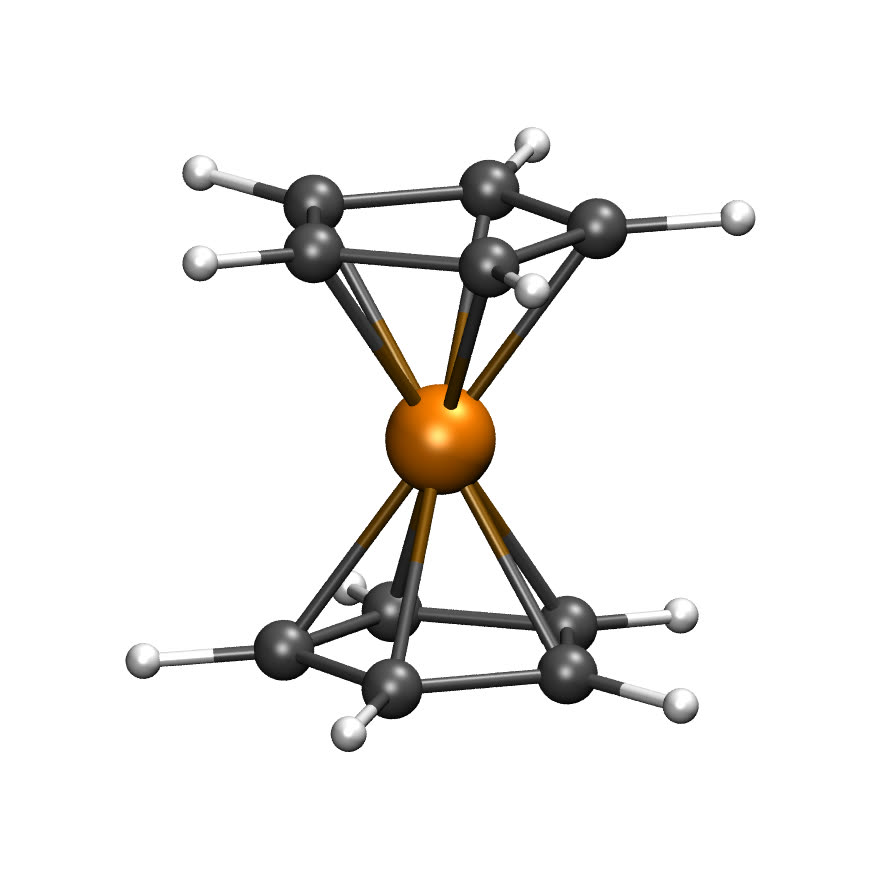
Ferrocene as the template ships it. The ten Fe–C contacts fall between 2.064 and 2.066 Å; gas-phase electron diffraction measures 2.064 Å. Nothing declares that bonding — the graph builder infers it from interatomic distance against covalent radii, so η⁵ coordination falls out of the geometry.
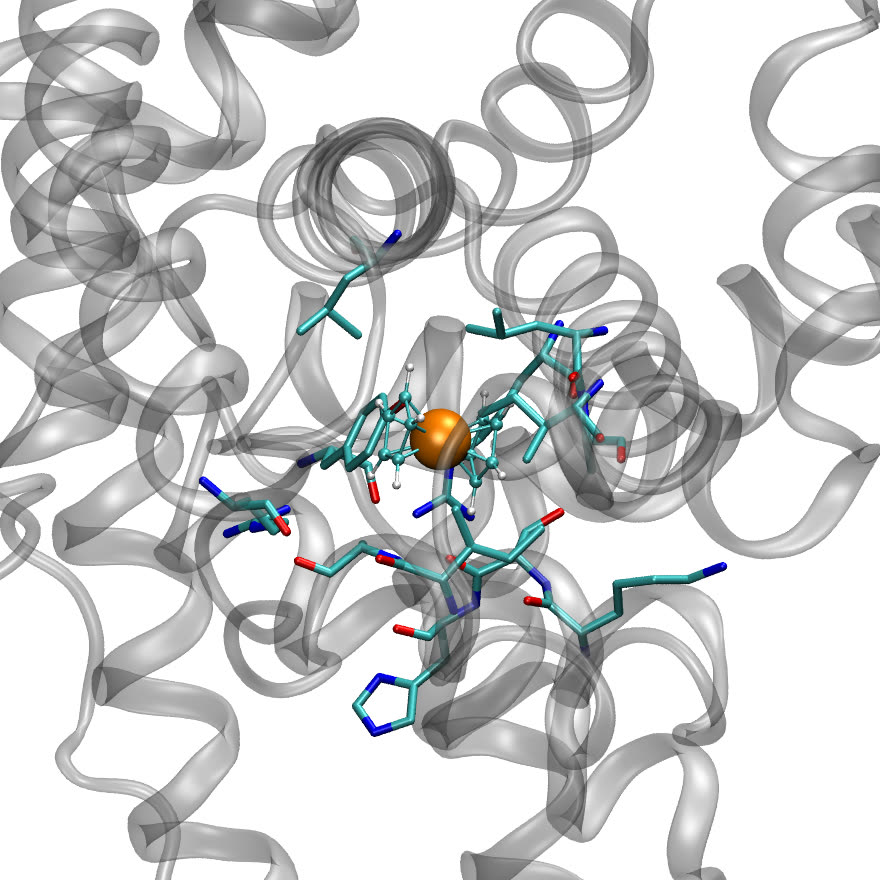
The best-scoring pose. Closest approaches, hydrogens included: ILE290 1.5 Å, LEU260 1.5 Å, LEU238 1.9 Å, SER287 1.9 Å, ARG257 2.0 Å.
The pipeline
Six nodes in a line. Each writes into the working directory and hands what it made to the next, so a parameter left empty is inherited, not unset.
1 · Protein Prep — pdb2pqr30, prepare_receptor4
Strips every HETATM record, adds hydrogens at a chosen pH, writes a PDBQT with partial charges and atom types.
| takes | 1ao6_A.pdb — albumin, chain A, 578 residues |
| writes | clean_1ao6_A.pdb, 1ao6_A_protonated.pdb, clean_1ao6_A.pdbqt |
| set here | ph 7.4 · clean true |
Stripping all HETATM removes ligands, cofactors and waters alike — so a heme would go too, which matters if you dock into a metalloprotein.
2 · Ligand Prep — OpenBabel
Builds the molecular graph: which atoms exist, which are bonded.
| takes | ferrocene.xyz |
| writes | ferrocene_c.xyz, mol_graph.json — 21 atoms, 30 bonds |
| set here | metal_symbol Fe |
The 30 bonds are 10 C–H, 10 C–C and 10 Fe–C.
3 · QM Charges — GFN1-xTB
Computes per-atom partial charges and bond orders, and writes them onto the graph. Docking scores electrostatics, and a metal centre needs charges no force field supplies.
| takes | mol_graph.json, ferrocene_c.xyz — both inherited |
| writes | enriched_graph.json — CM5 charges, Wiberg bond orders |
| set here | engine xtb · charge 0 · spin 0 |
CM5 charges require GFN1. GFN2 returns Mulliken only.
4 · Ligand PDBQT
Converts the enriched graph into AutoDock’s ligand format and decides which bonds may rotate. Bonds inside the coordination sphere are frozen so the complex cannot pull itself apart during the search.
| takes | enriched_graph.json |
| writes | hsa_fe_ligand.pdbqt |
| set here | freeze_coordination_sphere true · vacant_site false |
A vacant coordination site is marked with a DD dummy atom, which AutoDock
scores as a hydrogen-bond donor. Ferrocene is saturated, so the template leaves
vacant_site off. Before 0.4.2 it was on, and every run carried a dummy 1.0 Å
from the iron; turning it off moved the best pose by 0.02 Å and its score from
−3.01 to −3.00 kcal/mol.
5 · AutoDock Run — autogrid4, autodock4
Builds the energy grids, then runs the genetic-algorithm search.
| takes | hsa_fe_ligand.pdbqt, clean_1ao6_A.pdbqt, enriched_graph.json |
| writes | *.map, hsa_fe_ligand_clean_1ao6_A.dlg, hsa_fe_ligand_1…10.pdbqt |
| set here | box_center 34.64,32.92,36.18 · box_size 20,20,20 · num_poses 10 |
The box centre is the choice that decides the result. Left empty it centres on the ligand’s own metal atom, which is only meaningful if the ligand’s coordinates came out of the receptor’s crystal. Here it is Sudlow site I, taken from R-warfarin co-crystallised in 2BXD and transferred into the 1AO6 frame by superposition over all 578 Cα atoms (RMSD 0.88 Å). Centring instead on the centroid of Trp214 — the residue that lines the site — lands 9.7 Å away, puts the pocket on the box boundary, and returns a weaker pose (−2.63 kcal/mol, residues 328–354) in the wrong subdomain without any error.
On the iron. Fe, Zn and Mn are the three metals MetalDock supplies no fitted
parameters for; they fall back to AutoDock 4’s stock atom_par line, while every
other metal gets four re-fitted pairwise well depths. Fe’s stock line is
Rii 1.30 Å, epsii 0.010 kcal/mol — 87x shallower than Mn’s 0.875, 15x shallower
than aliphatic carbon’s 0.150 — so the iron adds almost no dispersion and reaches
the score through its xTB charge instead. Here
that is fine: the iron sits between two Cp rings and barely touches protein, so
the carbons do the binding. Read the number with more caution for an Fe complex
whose metal is exposed and coordinating protein donors.
6 · Results Analysis
Reads the docking log: binding energy per pose, ligand efficiency, and which residues line each pose.
| takes | the .dlg, clean_1ao6_A.pdb |
| writes | hsa_fe_analysis.json |
| set here | cutoff 4.0 · reference_xyz empty |
reference_xyz is empty because there is no crystallographic pose to compare
against, so no RMSD is computed.
Looking at the result
Two files, already in the same coordinate frame:
vmd protein/clean_1ao6_A.pdb docking/hsa_fe_ligand_1.xyz_1 … _10 are numbered in the order AutoDock ran them, not by score;
binding_energies in hsa_fe_analysis.json lists them in the same order, and
best_pose_index names the best, counting from 0. Here all ten land in the same place
(within 0.08 Å of each other), so _1 shows the result. The .pdbqt poses hold
identical coordinates and also open, but VMD needs telling they are PDB
(mol new … type pdb).
Of the rest of docking/: the .dlg is the log, .gpf/.dpf are inputs, and
the .map grids will not open in VMD — they are AutoGrid format, not CCP4.
clean_1ao6_A.maps.xyz holds the box extents, which read back as the centre and
size set above.
Expected result
poses 10   best −3.00   median −3.00   spread under 0.01 kcal/mol

contacts 11–12:
  TYR150  ARG222  LEU238  ARG257  LEU260  ALA261
  ILE264  LYS286  SER287  HIS288  ILE290  ALA291
The iron lands 3.6 Å from the box centre, which is where warfarin sits in 2BXD: ferrocene docks into the warfarin pocket. The energy is modest because ferrocene is small and neutral; the pose is the result worth reading.
The exact contact count varies between runs — AutoDock seeds its search from
pid time, and HIS288 is the one that comes and goes. The binding energy, the
convergence and the pocket do not vary; judge a re-run on those.
Regenerating the figures
workflows/vmd/ holds the TCL. Both renders come from a real run of this
template, using VMD’s Tachyon renderer with no display attached.
Where these numbers come from
- Runtime, energies, contacts, the iron’s place and the spread of the poses:
three runs of this template (metaldock-vwf 0.4.2) on an Intel Mac on
2026-09-24, each node run by
bocoflow_core.node_runnerin the package’s own environment, as the app runs it. They took 148–155 s, 135–142 s of it in AutoDock. On an earlier version of the template, an Apple Silicon Mac mini running it under Rosetta took 155 s and 191 s (2026-09-04), and a Windows PC through WSL2 about two minutes (2026-09-05). - Closest approaches: the run of 2026-08-25 that rendered the figure; the 2026-09-24 runs give the same five to within 0.07 Å.
- Fe–C distances: the shipped
ferrocene.xyz, a GFN1-xTB geometry. The measured value is gas-phase electron diffraction: Haaland, A.; Nilsson, J. E. Acta Chem. Scand. 1968, 22, 2653. - Box centre, the 0.88 Å superposition and the Trp214 attempt: our own site
selection on 2026-08-25, recorded in
CHANGELOG.md0.4.0. 2BXD is from Ghuman, J. et al. J. Mol. Biol. 2005, 353, 38–52; 1AO6 is from Sugio, S. et al. Protein Eng. 1999, 12, 439–446. - Well depths: AutoDock 4’s parameter library, the
atom_parlines in_vendor/metaldock_modules/data/metal_dock.dat.
Watch
Filmed on Apple Silicon with Salpa 0.3.2, where this package installs and runs through Rosetta. It replaces two earlier clips that split the same story between them and opened with a platform caption that is no longer true.